

Planning for retirement is one of the most important financial decisions in life. With rising life expectancy and inflation, relying only on traditional savings may not be enough. This is where the National Pension System (NPS) plays a crucial role. To estimate how much corpus you can build through NPS and what kind of pension you may receive after retirement, an NPS Calculator becomes an essential planning tool.
In this article, we will explain what an NPS Calculator is, why it is important, and how to use an NPS Calculator step by step, so you can make informed decisions about your retirement savings.
An NPS Calculator is an online financial tool that helps you estimate:
Total retirement corpus at the age of 60
Monthly pension (annuity) after retirement
Lump-sum amount you can withdraw
Contribution growth based on expected returns
The calculator works on the principle of long-term compounding and takes into account your regular contributions, expected rate of return, and remaining years until retirement.
The National Pension System is designed specifically for long-term retirement planning and offers several advantages:
Encourages disciplined monthly or annual savings
Offers market-linked returns with professional fund management
Provides tax benefits under Section 80C and 80CCD(1B)
Helps create a stable pension income after retirement
Suitable for salaried employees, self-employed individuals, and professionals
Because NPS investments span decades, even small monthly contributions can grow into a large retirement corpus.
NPS investments are allocated across different asset classes such as:
Equity (E)
Corporate Bonds (C)
Government Securities (G)
Returns depend on market performance, but over the long term, compounding plays a powerful role in wealth creation.
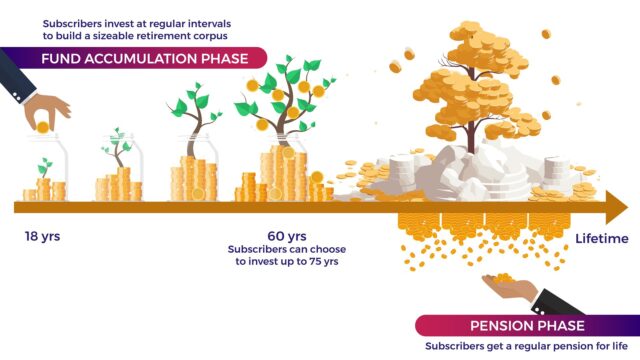
The longer you stay invested, the greater the impact of compounding, making early entry into NPS highly beneficial.
Most NPS calculators ask for the following details:
Current age
Retirement age (usually 60 years)
Monthly or annual contribution
Expected annual rate of return
Percentage of corpus to be used for annuity
Expected annuity return rate
Based on these inputs, the calculator projects your retirement outcomes.
Using an NPS calculator is simple and does not require technical or financial expertise.
Step 1: Enter Your Current Age
Input your present age. This helps the calculator determine how many years your contributions will remain invested until retirement.
Step 2: Enter Retirement Age
The default retirement age in NPS is 60 years, though contributions can continue up to 70 years in some cases.
Step 3: Enter Your Monthly or Annual Contribution
Enter the amount you plan to invest regularly.
Even a small contribution like ₹2,000–₹5,000 per month can grow significantly over time.
Step 4: Select Expected Rate of Return
Most calculators allow you to enter an expected annual return (commonly between 8% and 12%).
This is an estimate based on long-term market performance.
Step 5: Choose Annuity Allocation Percentage
At retirement:
At least 40% of the corpus must be used to purchase an annuity
Up to 60% can be withdrawn as a lump sum
Select the percentage you want to allocate to annuity.
Step 6: Enter Expected Annuity Return Rate
This rate determines how much monthly pension you will receive from the annuity portion.
Typical assumptions range from 5% to 7% per annum.
Step 7: Click on “Calculate”
Once you click calculate, the NPS calculator instantly shows:
Total retirement corpus
Lump-sum withdrawal amount
Amount used for annuity purchase
Estimated monthly pension
Assume:
Current age: 30 years
Retirement age: 60 years
Monthly contribution: ₹5,000
Expected return: 10% per annum
Annuity allocation: 40%
Annuity return: 6%
Estimated results (approximate):
Total retirement corpus: ₹1.1–1.3 crore
Lump sum withdrawal: ₹65–75 lakh
Monthly pension: ₹22,000–25,000
This example shows how consistent investing and time can create a strong retirement income.
Clear retirement planning
Instant and accurate projections
Better contribution planning
Helps choose annuity options wisely
Motivates early and consistent investing
Allows scenario comparison (different returns, contributions, retirement ages)
Although calculators automate everything, NPS calculations are based on compound interest:
Contributions are added regularly
Returns are compounded annually
Final corpus is split into lump sum and annuity
Pension is calculated based on annuity rate
You don’t need to calculate this manually—the calculator handles all the complexity.
Assuming guaranteed returns (NPS is market-linked)
Using unrealistic return assumptions
Ignoring inflation while planning pension
Starting NPS too late
Overlooking annuity rate impact on pension
Using realistic inputs ensures more accurate retirement planning.
Young professionals starting their careers
Salaried employees looking for retirement savings
Self-employed individuals without EPF
People planning a stable post-retirement income
Anyone serious about long-term financial security
An NPS Calculator is a powerful and essential tool for anyone planning retirement through the National Pension System. By understanding how NPS works and learning how to use an NPS calculator, you can estimate your retirement corpus, pension income, and make informed decisions well in advance.
NPS rewards patience, consistency, and early planning. The earlier you start and the smarter you plan using an NPS calculator, the more comfortable and financially secure your retirement can be.

Ahalts is a pioneering technology company dedicated to empowering businesses with innovative services and solutions that transform them into strategic enterprises.
